Commercial Solar EV Charging for UK Businesses
Rooftop or canopy solar feeding workplace and fleet chargers, designed as one system. Independent, sourced guidance on commercial solar EV chargers, costs, grants, tax and grid connection — and a free combined feasibility for your site.
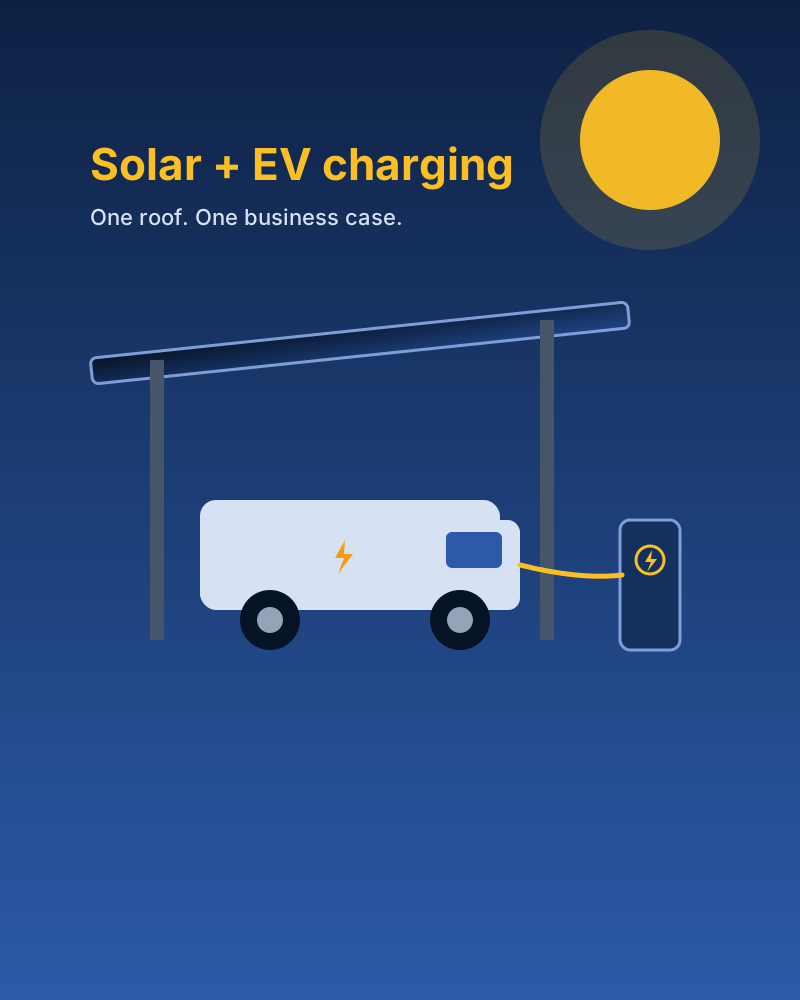
Why commercial solar EV charging is one project, not two
Commercial solar EV charging works because the two technologies fix each other's weak spots. A solar array on a five-day business produces much of its output when the building is lightly loaded, so a share of it is exported at whatever the export tariff pays. Workplace and fleet chargers are the opposite: a large, flexible load that can be scheduled into the hours the array is producing. Put them on the same site distribution board with a load controller between them and the surplus becomes vehicle energy instead of cheap exports, while the chargers draw less from a grid that averaged 24.14p/kWh for UK businesses in the first quarter of 2026.
Designing them together also removes duplicated work. The site's supply capacity is assessed once. The distribution network operator (DNO) sees one coherent picture — new generation and new demand — instead of two unrelated applications a year apart. And trenching, ducting and switchgear are specified for the end state, so phase two does not reopen the car park. Where supply headroom is tight, dynamic load management is usually the first answer to test before anyone prices a supply upgrade.
This site covers each part of that stack: the EV charging business case, how the engineering works, what a system costs to install, the capital allowances on each half, the G98, G99 and DNO rules, the Workplace Charging Scheme, canopies for sites without a usable roof and fleet depots, where the numbers get large.
The 2026 numbers, with their sources
Every figure below is dated and linked to the body that publishes it. Where a number is our own arithmetic rather than a published statistic, the table says so and shows the working. To test the figures against your own vehicles, use the EV charging cost calculator.
| What | Figure | Source |
|---|---|---|
| Average UK non-domestic electricity price, incl. Climate Change Levy | 24.14p/kWh (Q1 2026; 21.42–25.00p across consumption bands) | DESNZ Quarterly Energy Prices, table 3.4.2 |
| Installed cost of 10–50 kW non-domestic solar PV | £1,167 per kW (mean, 2025/26) | DESNZ Solar PV cost data, published 28 May 2026 |
| Annual yield per kW of panels | London 1,019 kWh at 35°, 920 kWh at 10°; Manchester 886 / 807; Glasgow 853 / 772 | EU JRC PVGIS 5.3 (SARAH3, 14% system losses) |
| Capital cost of solar electricity over 25 years | about 5.4p/kWh (London, 10° roof) to 6.4p/kWh (Glasgow) | Our arithmetic: cost per kW ÷ (yield × 25 years × 0.94 for 0.5%/yr degradation). Excludes finance and maintenance. |
| Public charging price, pay-as-you-go | 54p/kWh on 3–49 kW chargers; 77p/kWh on 50 kW+ (August 2026) | Zapmap Price Index |
| Workplace Charging Scheme | up to £500 per socket, max 75% of cost, 40 sockets across all sites (£20,000); closes 31 March 2027 | GOV.UK Find a Grant |
| First-year allowance on new chargepoints | 100% of qualifying spend to 31 March 2027 (Corporation Tax) / 5 April 2027 (Income Tax) | HM Treasury policy paper, 26 Nov 2025; CAA 2001 s45EA |
| Annual Investment Allowance | 100% relief on up to £1m of plant a year, including solar (special-rate) | GOV.UK; HMRC Capital Allowances Manual CA22335 |
Two consequences follow. First, every kilowatt-hour a vehicle takes from the array instead of the grid is worth roughly the grid price, not the export price — that is the whole reason to combine the systems. Second, even grid-fed workplace charging at around 24p/kWh is far cheaper than public charging at 54–77p, so a business that moves its vehicles onto its own site wins twice: once on the grid-versus-public gap, again on the solar-versus-grid gap. The cost-per-mile comparison works this through in pence per mile.
Commercial solar EV chargers: what actually makes a charger work with solar
There is no special cable from panel to plug. On a business site the array feeds the building's distribution through its inverters, the chargers draw from the same distribution, and the grid covers any shortfall. What turns that into solar charging is control: something has to measure how much generation is spare at the supply intake and tell the chargers how much to draw. When comparing commercial solar EV chargers, check these points rather than the marketing name of a "solar mode" — and for the plain-English version, see whether you can charge an EV directly from solar panels.
- Surplus measurement. A solar-following mode needs a reading of site import and export — usually a CT clamp or meter at the intake, or data from the site energy management system. Without it a charger cannot know what is spare.
- Open protocol. Chargers that speak OCPP can be managed by any compatible back-office platform, so the site is not tied to one vendor's software pricing for the life of the hardware.
- Dynamic load management. The controller keeps total site demand under the supply limit while sharing power between sockets. On most workplace sites this, not the solar mode, is what decides how many sockets the existing supply can carry.
- 7 kW or 22 kW. Three-phase 22 kW AC units only help vehicles whose on-board charger accepts it; many cars take 7–11 kW on AC. Long-dwell staff parking is usually well served by 7 kW sockets, which also track a modest solar surplus more smoothly.
- Metering and billing. If staff or visitors will pay, the charger and back office need to meter each session reliably, and charging staff for electricity has its own tax and VAT treatment — see whether a company can pay for employees' charging.
- Regulation and grant eligibility. The Electric Vehicles (Smart Charge Points) Regulations 2021 set smart-functionality and security requirements for charge points sold for home and workplace use in Great Britain. For the Workplace Charging Scheme, the model must be on the approved list and fitted by an OZEV-authorised installer.
The guide to choosing commercial chargers goes deeper on hardware; the point here is that the "solar" in solar EV charging is a control and design decision, so it belongs in the specification before anyone compares unit prices.
Who a combined system suits
Workplaces with staff parking. Offices, hotels, business parks and campuses where cars sit for six to nine hours. Long dwell times let slow AC sockets follow the array's output, and the Workplace Charging Scheme can fund up to £500 of each socket. Note the rule most summaries miss: a business applicant's WCS-funded chargers are for staff and fleet use, while charities, public bodies and small accommodation businesses may open them to visitors and guests.
Fleets that return to base. Vans and cars parked at a depot during working hours can absorb daytime generation; vehicles out all day charge overnight from the grid, where the solar contribution is zero unless there is a battery. The fleet depot charging guide shows how duty cycle, not array size, sets the solar share. Fleet operators should also note the Depot Charging Scheme, whose second application window is expected from 28 October 2026.
Sites without a usable roof. Where the roof is shaded, leased or structurally unsuitable, a solar canopy puts the generation over the parking bays themselves. Canopies cost more per kW than rooftop arrays because of the steel and foundations, and a 10° canopy yields roughly 10% less than a 35° roof in the same place.
The honest constraints
Solar produces in daylight, and much more in summer: in London, a well-angled array generates about three times as much in June as in December. Overnight depot charging is grid charging unless you add storage. Rapid DC chargers draw more power than most arrays produce at any moment, so they are grid-led with a solar offset rather than solar-fed. And every site lives within its supply capacity until the DNO agrees otherwise — which is why the grid connection position is the first engineering question, not an afterthought. A pitch that promises "free fuel from the sun" without those caveats is not describing a real site.
How a combined project normally runs
This is the sequence to expect from a competent installer or consultant, and the order in which to ask for evidence.
- Desk feasibility. Twelve months of half-hourly meter data, the parking or fleet schedule and the site address are enough to model array size, charger count and type, supply headroom, grant eligibility and cash flow. Ask for the model's assumptions in writing.
- Survey and grid strategy. A structural survey for the roof or canopy, an electrical survey of the intake and boards, then the DNO route: G98 notification or a G99 application for the generation, and the DNO's process for the new charging demand.
- Grant and tax position. The WCS voucher is applied for before installation and redeemed by the OZEV-authorised installer. Capital allowances are claimed afterwards through the tax return — the allowances guide explains which relief applies to which half, and the WCS-and-solar guide covers the order of steps.
- Install, commission, prove it. The handover should demonstrate the load controller holding the site under its supply limit with every socket active, and the solar-following mode responding to real surplus.
If you would rather start from figures than from a sales call, the form below asks for the few facts a first-pass model needs. Common questions are answered in the solar EV charging FAQs.
Commercial solar EV charging — common questions
Why combine solar with EV charging rather than do them separately?
Because each fixes the other's weakness. Chargers that follow the solar surplus turn electricity that would have been exported at the export tariff into vehicle energy worth the grid price — 24.14p/kWh on average for UK businesses in Q1 2026 (DESNZ). Designing both together also means one supply assessment, one grid plan covering generation and demand, and groundworks specified once.
How much does a combined solar and EV charging system cost?
On the solar side, DESNZ data put the average non-domestic 10–50 kW system at £1,167 per kW installed in 2025/26, so a 50 kW roof array is roughly £58,000 on that average. Charger costs depend mostly on groundworks, distance from the distribution board and supply capacity; the Workplace Charging Scheme takes off up to £500 per socket. The cost guide has a worked example.
What grants are there for commercial solar EV charging in 2026?
The Workplace Charging Scheme pays up to £500 per socket (up to 75% of cost, 40 sockets across all sites) until 31 March 2027. There is no national grant for business solar in England; the solar half is supported through the Annual Investment Allowance, and new chargepoints get a 100% first-year allowance to 31 March 2027 for companies.
Can solar panels charge electric vehicles directly?
Yes, through the building's electrical system rather than a dedicated cable: the array and the chargers share the site distribution, and a controller reading the supply intake tells the chargers how much surplus there is. It only works while vehicles are parked in daylight, and output is seasonal — in London a well-angled array produces about three times as much in June as in December.
Do workplace chargers have to be smart?
The Electric Vehicles (Smart Charge Points) Regulations 2021 set smart-functionality and security requirements for charge points sold for home and workplace use in Great Britain. For Workplace Charging Scheme funding the model must also be on the approved list and fitted by an OZEV-authorised installer.
Who runs this site
Commercial Solar EV is an independent information site operated by SEO Dons Ltd. It is not an installer and does not hold installer accreditations; the MCS, OZEV and NICEIC registers are there for you to check whoever you appoint. Figures are taken from government and industry sources and dated, and the arithmetic is shown where we have done our own. How the site is researched and paid for is set out in the editorial policy; if a figure here has gone out of date, the contact page reaches the editor.
Free combined feasibility
Get combined solar + EV charging figures for your site
Tell us about the site and the vehicles. The reply is a written desk feasibility — array size, charger plan, grid headroom, grant and tax position — within 7 working days, from twelve months of meter data if you have it. No site visit is needed for that first pass.
Domestic drivers get the same on-site benefit: solar EV charger installation lets an EV charge from the roof via a solar-diverting charger.
Further reading: Pairing solar with a smart charger lets an Edinburgh driver charge from their own roof and top up on cheap overnight units, so for home or workplace EV charger installation Edinburgh use an installer who can integrate the charger with an existing or planned PV and battery system.
Further reading: Pairing chargepoints with generation directly overhead is cheapest via EV-integrated solar canopies, where the canopy columns carry power to the bays below.
Car parks pairing chargers with generation increasingly choose solar EV charging canopies so the shelter and the power come from a single structure.
Further reading: The funding routes for a combined solar and EV-charging project are compared by Commercial Solar Finance.